We offer garden lighting design across the whole of Littleborough, including Smithy Bridge, Summit and Calderbrook, as well as nearby Rochdale, Todmorden and Shaw. We visit, measure and talk through the options with you first, then send a written, itemised quote for your Littleborough garden.
Garden lighting design is the planning stage that decides what gets lit, how, and from where. At Littleborough Landscaping & Driveways we produce lighting designs for homeowners across Littleborough who want a scheme that looks considered rather than a row of spike lights from a garden centre. The service suits anyone building a new garden, relaying a patio or driveway, or simply tired of a dark plot after five o'clock in winter. You get a plan, a fittings schedule and a cable layout, and you can have us install it, fit it yourself or hand it to another trade.
Our designers are landscapers first. That matters because light behaves differently on a flat-faced wall, a clipped hedge and a gravel path, and because the cable has to get from the transformer to each fitting through beds, under paving and around roots. We design with those routes in mind so that what we draw can actually be built. Every design visit in Littleborough includes time after dark where possible, with demonstration fittings so you can see the effect before anything is bought.
Where We Offer Garden Accent Lighting Design
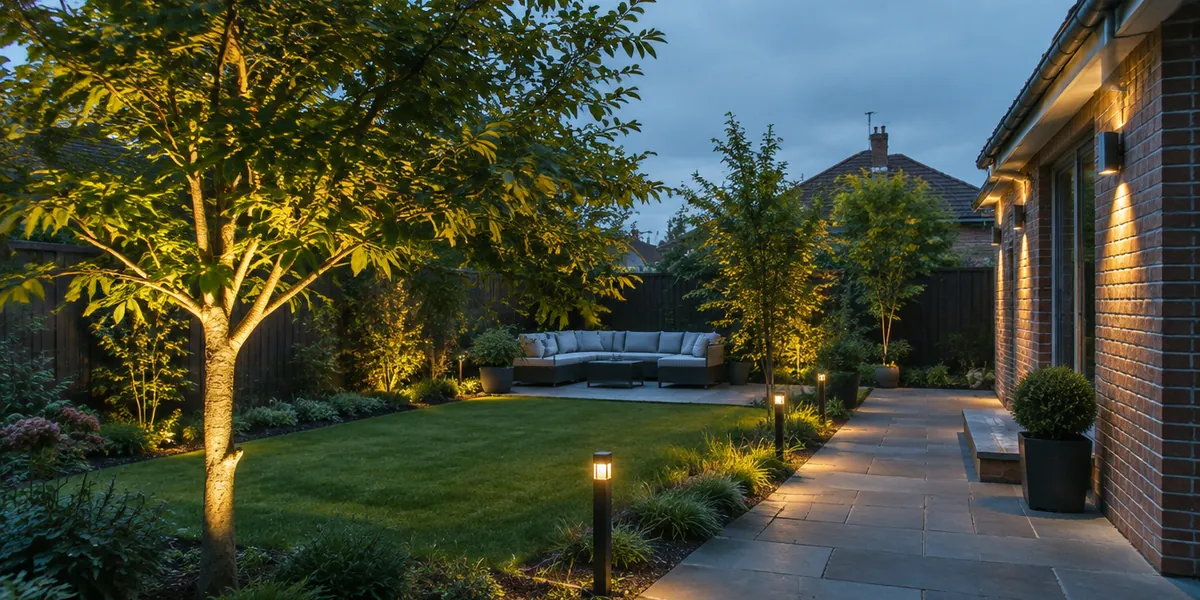
Accent lighting picks out individual features and leaves the rest in shadow. It is what gives a garden depth at night: a lit birch at the far end makes the plot feel longer, a grazed brick wall shows its texture, a single bowl of water throws moving light onto a ceiling of leaves. Accent design in Littleborough gardens usually works with three or four features at most. More than that and everything competes.
We choose a technique for each feature. Uplighting from a ground spike suits trees with open canopies and interesting bark. Downlighting from a pergola beam or a fixing high in a tree gives a moonlight effect over a seating area. Grazing places a fitting close to a wall or fence so light skims across the surface and shows every joint and ripple. Silhouetting puts the light behind a plant against a pale wall. Each needs a different beam angle and output.
Fittings for accent work are mostly brass or copper spike spots, which weather to a dark brown that disappears among planting. Colour temperature is usually 2700K; anything cooler makes foliage look grey. We note on the plan where glare could be a problem for a neighbour or from a bedroom window and specify glare guards or shrouds. The design also allows for growth, so a fitting lighting a young tree can be moved outward as the canopy spreads.
Pathway Lighting Design
Pathway lighting is practical first: you should be able to walk from the back door to the shed, or from the pavement to the front door, without a torch. The mistake is the runway, with identical bollards every metre on both sides. Our pathway designs for Littleborough homes use fewer fittings, staggered rather than paired, and placed where the path changes direction, meets a step or passes something worth seeing.
The fittings are low-level by nature. Bollards between 300 mm and 700 mm tall throw a pool of light down and outward; spread lights on short stems sit among planting at the path edge; recessed in-ground fittings work in paving where there is nothing to knock over. All of them should be shielded so the light source is hidden and only the ground is lit. We work out spacing from the beam spread and mounting height, usually ending up at two to three metres between fittings on a straight run.
Where the path is a front garden route to a driveway, the design also has to deal with vehicles: fittings are set back from the car's swing or recessed flush. We specify warm white and a modest output; a path needs guidance light, not floodlight. The plan shows each fitting, its height and lamp, and the cable route, usually in a duct laid when the path is built or in the adjacent border when it is not.
Outdoor Living Area Lighting Design
Patios, decks, dining terraces and outdoor kitchens need more than one kind of light. Someone cooking at a built-in barbecue needs clear task light over the worktop. A table of people eating wants a lower, warmer level that does not glare. Later in the evening, with drinks and a fire bowl, most people want the lighting lower still. A single bright wall light does none of this well. Our designs for outdoor living areas in Littleborough layer two or three circuits that can be switched or dimmed separately.
Task lighting is usually a downlight recessed into a pergola or a wall-mounted fitting aimed at a worktop. Ambient light comes from wall washers, concealed LED strip under a bench seat or a step nosing, or festoon-style strings across a pergola. Accent light within the area picks out a planted pot or a feature wall. We keep direct fittings out of the eyeline of anyone sitting down, which usually means mounting high and aiming down, or low and aiming away.
Controls matter here more than anywhere else. We specify dimmable LED drivers, zoned switching from inside the house, and often a simple app or remote so the lights can be adjusted from the table. Outdoor sockets, the transformer position and any mains work are shown on the plan so a Part P registered electrician can price their part.
Why Choose Us for Garden Lighting Design in Littleborough
A lighting design from Littleborough Landscaping & Driveways is drawn by people who will be, or could be, digging the trenches. We know how deep a duct can go under a block-paved path, where tree roots will be, and which fittings survive a strimmer. That practical grounding keeps the design buildable and the cost sensible.
We demonstrate before we specify. Our visit kit includes spike spots, a bollard, a wall washer and a length of LED strip on a battery pack, so you see the real effect on your own wall and trees rather than trusting a catalogue photograph. We write the design up as a plan with a fittings schedule, transformer sizing and cable lengths, which means any installer can price it accurately and nothing is left to guesswork on the day.
You own the design. Have us install it through our Garden Lighting Installation service, or use it with a different trade; either way it is yours. And because we also carry out Garden Lighting Maintenance, we specify fittings we know can be repaired, not sealed units that have to be binned when a lamp fails.
How Our Garden Lighting Design Works
- Brief. We talk through how you use the garden, what you want to see from indoors, and any neighbours, bedrooms or wildlife to consider.
- Daytime survey. We measure the plot, note the levels, walls, trees, existing power and the route from the consumer unit to the garden.
- Dusk visit with demonstration fittings. We try spots, washes and strip on the actual features so you can see what works.
- Draft plan. You receive a marked-up plan with fitting positions, techniques and beam angles for comment.
- Fittings and controls schedule. We finalise products, colour temperatures, transformer sizing, cable routes and switching or app control.
- Issue. The final design pack goes to you with a written quote for installation if you want us to fit it.
For a small front garden in Littleborough the whole process can take a week. Larger plots with several zones and a pergola usually take two or three, mostly waiting on dusk visits and your comments on the draft.
What Affects the Cost of Garden Lighting Design in Littleborough
Design cost depends mainly on the size and complexity of the garden. A single rear garden with a path, a patio and two trees is a short job; a plot in Littleborough with front and rear gardens, a side return, steps, a pond and an outdoor kitchen takes several visits and a longer document.
The number of zones and circuits matters, because each one needs its own switching, driver and cable calculation. Dimming and app control add design time. If the design has to coordinate with a new patio, driveway or pergola being built at the same time, we spend time with the other drawings so ducts and fittings land in the right places.
Whether we can visit at dusk easily affects it too, as does access for the survey. A specification for another installer to price, with product codes and a full schedule, is more detailed than a design we will install ourselves. Either way the design fee is set out in writing before we start.
Garden Lighting Design Around Littleborough
We produce lighting designs throughout Littleborough. In Smithy Bridge, if your rear garden is long and disappears into darkness beyond the patio, we plan a scheme that draws the eye to the far end. Front-garden and step lighting is a frequent request in Wardle and Hollingworth Lake, and where a front garden is small it needs a light touch. In Calderbrook, if you have mature trees, they give us plenty to uplight, and in Summit we design around existing decking and pergolas, as we do on any newer home. We also take on design work in nearby Rochdale, Todmorden and Shaw, and dusk visits are arranged to suit the season.
Frequently Asked Questions
Can I have a garden lighting design without having you install it?
Yes. The design pack is a standalone product with a plan, fittings schedule, transformer and cable calculations and control details. You can fit it yourself, give it to an electrician or landscaper, or come back to us for installation later. The fee is quoted in writing before the first visit.
Why do you visit after dark?
Garden lighting is only ever seen at night, and a tree, wall or path looks completely different lit from the side rather than below. A dusk visit with demonstration fittings lets us test angles and brightness on your actual features, so the design is based on what you have seen rather than on a catalogue image.
How many lights does a typical Littleborough garden need?
Fewer than most people expect. A medium rear garden often works well with six to ten fittings across two or three features, a path and the patio. Restraint is the point: lit features need dark space between them to read properly. Larger plots with several zones naturally need more, and the design shows exactly why each fitting is there.
Do you design mains-voltage or low-voltage schemes?
Mostly low-voltage LED fed from a transformer, because the cable is safer to bury near planting, the fittings are smaller and the running cost is low. Where a mains fitting makes sense, for example a wall light on the house, we show it on the plan and note that a Part P registered electrician must connect it.
Will the design take account of neighbours and wildlife?
It does. We aim fittings away from neighbouring windows, specify shrouds where glare could spill, and keep output modest. For hedges and ponds used by wildlife we recommend timers so lighting switches off later in the evening, and we avoid lighting known bat flight lines or nesting areas.